
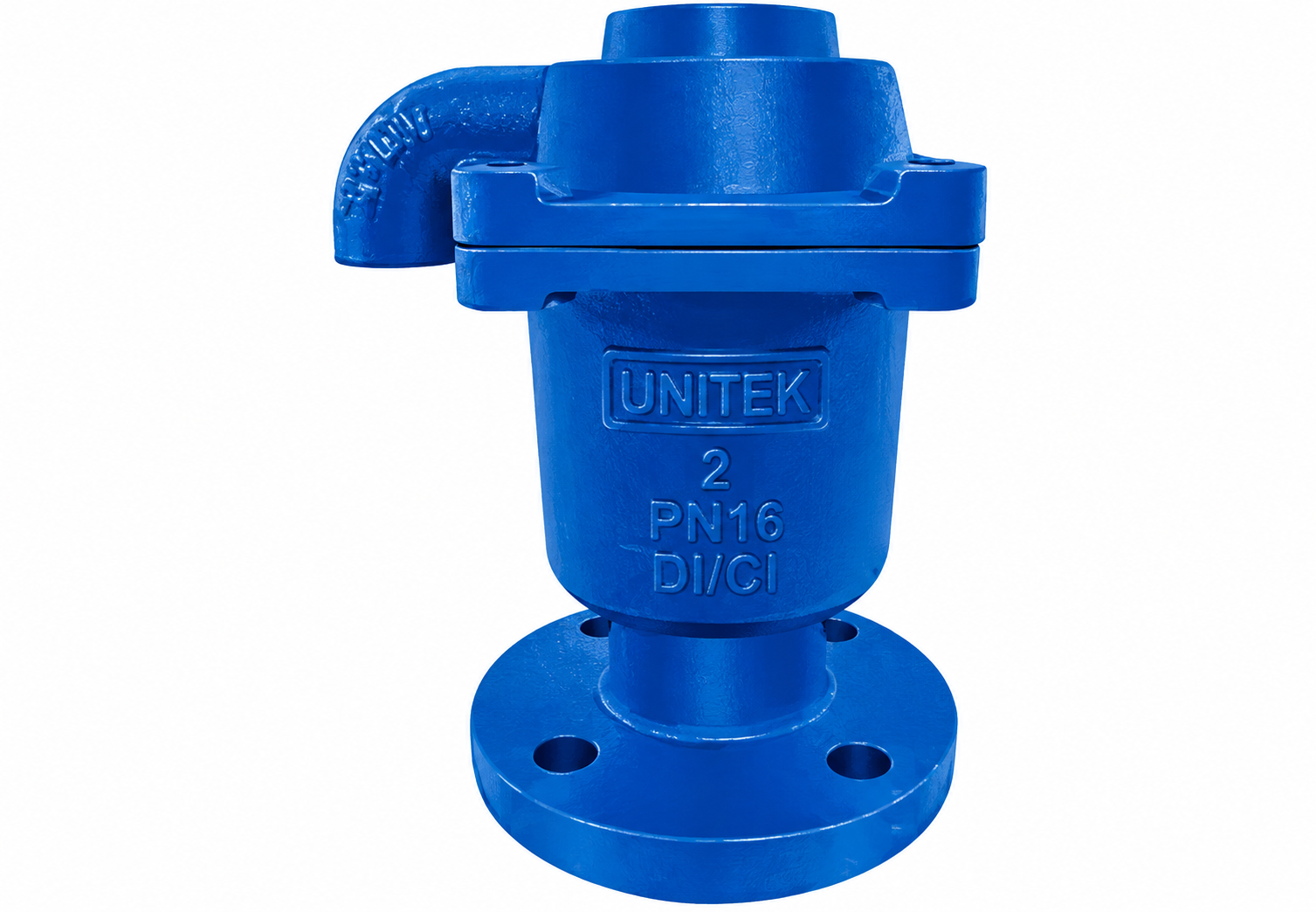
Air Release Valves
| Size Range : | 1½” (40 mm) To 6” (150 mm) |
| Pressure Rating : | PN 10 / PN 16 / PN 20 |
| MOC : | D.I. / C.S. / S.S. / C.I. |
| Float : | SS304 / SS316 |
| Gasket : | EPDM Rubber |
| Flange Drilling : | IS-1538 / Table D-E / Class150# |
Description
Air Release Valve Manufacturer in India
In pressurized liquid piping networks, fluid flow dynamics are frequently influenced by the presence of entrained or accumulated air. Left unmanaged, trapped gases can restrict flow capacity, create hydraulic instability, and induce operational issues across municipal and industrial utility systems. To maintain stable hydraulic performance, piping networks rely on specialized mechanical devices positioned at designated high points and accumulation zones. The Air Release Valve plays an essential role by automatically releasing accumulated air or gases from pressurized liquid pipelines.
Unitek Valves is a trusted manufacturer, supplier, and exporter of industrial valves in India, based in Mumbai. Catering to domestic and international markets, the company provides robust fluid control solutions engineered to meet the demands of water supply, water treatment, and industrial liquid piping infrastructure. This product page outlines the technical operating principles, structural characteristics, selection criteria, and application guidelines associated with air release valves.
What is an Air Release Valve?
An air release valve is an automatic mechanical valve installed on liquid pipelines to vent accumulated air or gases from the system while under pressure.
As water and other liquids flow through distribution networks, they often carry dissolved or entrained air that separates under changes in pressure and velocity, migrating to high points in the pipeline profile. If allowed to accumulate, these air pockets form restrictions that impede fluid motion. An air release valve automatically vents these pockets to the atmosphere, supporting efficient pipeline operation without requiring manual intervention.
How Does an Air Release Valve Work?
The operation of a typical float-operated air release valve relies on internal buoyancy dynamics responding to the presence of liquid versus air within the valve body:
-
Air accumulates: Entrained air travels through the pipeline and collects at high points or designated venting locations, entering the valve chamber.
-
Air displaces liquid: As air fills the upper portion of the valve body, the internal water level drops.
-
Float responds: The internal float or buoyant mechanism drops in response to the falling liquid level.
-
Valve opens: The downward movement of the float opens the discharge orifice, allowing accumulated air to escape to the atmosphere.
-
Liquid returns: As the air is expelled, incoming liquid fills the valve body, lifting the float back to its closed position against the seat.
Note: The exact internal mechanism, leverage arrangement, and sealing design depend on the specific valve configuration and manufacturer engineering specifications.
Why is Air Release Important in Water Pipelines?
Managing trapped air is critical for maintaining predictable hydraulic performance in water and liquid transport systems. Accumulated air pockets can contribute to:
-
Reduced effective flow area: Large air pockets displace liquid volume, effectively narrowing the cross-sectional flow area of the pipe.
-
Unstable hydraulic behavior: Fluctuating air volumes can cause flow surges and erratic pressure variations.
-
Increased operational issues: Pockets of air can restrict smooth transition across pipeline undulations.
-
Noise and vibration: Sudden compression or movement of air pockets can generate undesirable mechanical vibration in piping runs.
-
Reduced pumping efficiency: Pumps may experience decreased delivery capacity if air becomes trapped in discharge headers.
-
Potential operational difficulties: Unmanaged air pockets can complicate system commissioning and routine line filling.
Air Release Valve vs Air/Vacuum Valve
Piping designers utilize different types of air-management valves depending on the specific operational condition being addressed. The table below outlines key functional differences:
| Feature | Air Release Valve | Air / Vacuum Valve |
| Primary function | Automatically releases small pockets of accumulated air while the pipeline is under pressure. | Handles large volumes of air during pipeline filling (air venting) and draining (vacuum breaking). |
| Pipeline condition | Operates primarily under normal pressurized operating conditions. | Operates during transient or high-volume volumetric displacement events (drainage/filling). |
| General operating principle | Uses a small orifice and float mechanism to vent slow-accumulating pressurized air. | Uses a large orifice designed to handle high-volume air passage during pipeline filling or vacuum formation. |
| Typical application | High points of pressurized water mains, long continuous upward/downward slopes, and pump discharge lines. | Pipeline summits, system entry/exit points, and sections susceptible to rapid draining. |
Different air-management valves serve distinct functions and should not be treated as interchangeable without engineering review.
Main Components of an Air Release Valve
A standard air release valve is constructed from durable mechanical components designed to withstand continuous exposure to working fluids:
-
Body: The primary pressure-containing outer casting housing the internal water and air chamber.
-
Cover / Bonnet: The upper closure element bolted to the body to permit access to internal mechanisms.
-
Float: The buoyant internal member that regulates orifice opening and closing based on fluid levels.
-
Seat: The precision sealing surface against which the valve closure element seals.
-
Orifice: The calibrated discharge port through which air escapes to the atmosphere.
-
Internal mechanism / linkage: The levers or guides connecting the float to the sealing plug.
-
Flange or end connection: The mechanical interface securing the valve to the pipeline tapping.
Component arrangement and material details vary by valve design and manufacturer specification.
Features of Air Release Valves
Air release valves incorporate several practical engineering features:
-
Automatic air-release function operating continuously under system pressure without external power sources.
-
Float-operated mechanisms designed for responsive opening and closing cycles.
-
Compact valve arrangement suitable for installation at pipeline high points and air release chambers.
-
Flanged or threaded end configurations matching standard piping layouts.
-
Robust material construction tailored to water and liquid utility service requirements.
Advantages of Air Release Valves
Utilizing correctly specified air release valves offers multiple practical benefits in liquid distribution networks:
-
Helps remove accumulated air continuously from pressurized lines.
-
Supports proper pipeline operation by preventing severe air pocket restrictions.
-
Can reduce air-related operational problems such as localized flow reduction.
-
Automatic operation minimizes the need for manual air venting.
-
Useful in water and liquid distribution systems to maintain steady hydraulic conditions.
Applications of Air Release Valves
Air release valves are deployed across a wide range of water transport and industrial liquid networks. Suitable applications include:
-
Water supply pipelines
-
Municipal water distribution networks
-
Water treatment plants
-
Pumping stations
-
Industrial water pipelines
-
Agricultural irrigation systems
-
Cooling-water circuits
-
Suitable liquid utility pipelines
Actual application suitability depends heavily on system design, operating pressure, and pipeline profile.
Air Release Valve for Water Pipeline
In extensive water transmission and distribution mains, pipelines frequently follow the natural contours of the terrain, creating high points where entrained air naturally collects. Installing air release valves at these summits is a standard engineering practice.
Proper location selection ensures that air pockets are vented before they can restrict flow cross-sections or induce pressure fluctuations. Designers must evaluate pipeline profiles and hydraulic gradients to determine optimal positioning for each valve.
Cast Iron Air Release Valve
While air release valves can be engineered from various metal alloys and composite materials, cast iron is widely utilized for water supply, municipal utilities, and general industrial services due to its structural rigidity and pressure-resisting capabilities.
It is important to note that not every air release valve is made from cast iron. Where cast iron construction is specified, material compatibility, internal trim durability, and protective coating requirements must be verified against project parameters.
Flanged Air Release Valve
In municipal and industrial water pipelines operating under significant pressure, robust joint integrity is essential. Many air release valves are supplied with flanged end connections.
Flanged connections offer practical advantages such as:
-
Secure, rigid mechanical joint strength capable of withstanding pipeline loads.
-
Simplified alignment and bolting during initial installation or servicing.
-
Enhanced accessibility for periodic inspection and maintenance without requiring cutting of the pipeline.
Air Release Valve Selection
Engineers, consultants, and procurement teams must evaluate multiple parameters to select the correct air release valve for an installation:
-
Pipeline size and network layout.
-
Operating pressure limits of the system.
-
Fluid medium characteristics (e.g., raw water, potable water, treated effluent).
-
Pipeline profile and identification of high points.
-
Required air-release function (continuous venting under pressure).
-
Air volume and flow conditions expected during operation.
-
Material compatibility between valve components and the fluid.
-
End connection type (e.g., flanged).
-
Installation orientation and space availability.
-
Project specifications and applicable engineering standards.
Air Release Valve Manufacturer, Supplier & Exporter in India
Unitek Valves operates as a trusted manufacturer, supplier, and exporter of industrial valves in India, based in Mumbai. The company serves a diverse clientele including industrial buyers, EPC contractors, engineering consultants, and municipal infrastructure procurement teams.
Unitek Valves supports complex water infrastructure and industrial projects through:
-
Detailed technical requirement reviews.
-
Application-based product selection guidance.
-
Comprehensive domestic and export supply operations.
-
Professional customer support for industrial valve procurement.
Why Choose Unitek Valves for Air Release Valves?
Procuring critical flow control equipment requires partnering with an established manufacturer capable of meeting rigorous technical expectations. Sourcing from Unitek Valves offers distinct professional advantages:
-
Industrial valve expertise backed by extensive manufacturing and supply experience.
-
Application-based selection ensuring equipment matches operational duties.
-
Technical requirement review by experienced professionals.
-
Product configuration support tailored to specific piping layouts.
-
Project-specific requirements accommodation.
-
Domestic and export supply capabilities ensuring reliable logistics.
Installation & Maintenance Considerations
To ensure safe operation and dependable service life, operators should observe standard engineering practices:
-
Install at locations identified by the pipeline hydraulic design (typically high points and summits).
-
Ensure correct flow and installation orientation so the float mechanism operates vertically and freely.
-
Provide suitable access for inspection and maintenance.
-
Check the valve periodically for visible signs of leakage around cover joints or flange connections.
-
Inspect internal components (float, orifice, and sealing seat) according to service requirements and water quality.
-
Keep associated isolation valves and pipeline connections in suitable condition.
-
Follow manufacturer installation and maintenance instructions strictly.
Contact Unitek Valves
Submit your technical specifications, piping datasheets, or project enquiries to UNITEK VALVES PVT LTD for professional engineering support and commercial quotations on Air Release Valves.
Only logged in customers who have purchased this product may leave a review.

Reviews
There are no reviews yet.