
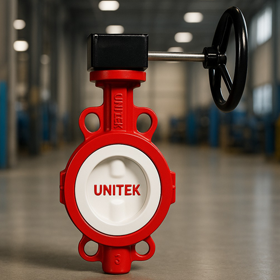
Cast Iron Butterfly Valve
| Size Range : | 1½” (40 mm) To 6” (150 mm) |
| Pressure Rating : | PN10 / PN16 |
| Body Material : | C.I. |
| Disc Material : | SS304 |
| Design : | Wafer Type |
| Operation Type : | Lever Operated & Gear Operated |
| Seat Material : | EPDM |
Description
Cast Iron Butterfly Valve Manufacturer in India
Introduction
In modern fluid transport and large-diameter piping infrastructure, achieving efficient flow isolation and space-saving valve integration are essential engineering priorities. Industrial piping networks across water treatment facilities, municipal utilities, and general fluid-handling systems rely on compact quarter-turn control devices to manage media movement. The Cast Iron Butterfly Valve serves this critical operational role by providing robust isolation and suitable flow-control capabilities within a streamlined structural footprint.
Unitek Valves is a trusted manufacturer, supplier, and exporter of industrial valves in India, based in Mumbai. Catering to domestic and international markets, the company provides robust fluid control solutions engineered to meet the demands of water supply, utility piping, and industrial liquid networks. This product page outlines the technical operating principles, structural characteristics, selection criteria, and application guidelines associated with cast iron butterfly valves.
What is a Cast Iron Butterfly Valve?
A butterfly valve is a quarter-turn rotational motion valve used to stop, start, and regulate fluid flow. The core design centers around a circular disc positioned in the middle of the pipe, which acts as the closing mechanism.
When constructed with a cast iron body, the valve provides durable structural rigidity suited for general water, utility, and liquid-handling services. The internal assembly typically consists of a disc connected through a stem or shaft to an external operating handle or gear mechanism, sealing against an internal seat ring when closed.
How Does a Butterfly Valve Work?
The operation of a cast iron butterfly valve relies on simple rotational mechanics:
-
Valve is closed: The disc sits perpendicular to the pipeline axis, blocking the flow path completely.
-
Operator rotates the shaft: Turning the manual handle or gear operator turns the internal shaft.
-
Disc rotates away from the closed position: The disc pivots within the flow stream, shifting parallel or at an angle to the direction of flow.
-
Flow passage increases: As the disc turns, the clearance around the perimeter opens up, allowing media to pass through.
-
Valve reaches the open position: A quarter-turn (90-degree) rotation positions the disc parallel to the flow, creating minimal flow obstruction.
-
Reverse rotation brings the disc back toward the seat: Turning the operator in the opposite direction pivots the disc back toward the closed position.
-
Valve reaches the closed position: Complete closure stops fluid motion.
Note: Actual operating characteristics and torque requirements depend on the specific product valve design.
Cast Iron Butterfly Valve vs Gate Valve
Piping designers select valve types based on their intended functional performance and spatial constraints within the plant layout. The comparison table below highlights key differences between butterfly valves and gate valves:
| Feature | Cast Iron Butterfly Valve | Gate Valve |
| Operating movement | Quarter-turn (90-degree) rotational motion. | Multi-turn linear motion requiring full stem travel. |
| Valve construction | Streamlined, lightweight body with a central rotating disc. | Heavier body structure with a sliding gate/wedge. |
| Space requirement | Compact face-to-face dimensions, requiring minimal installation space. | Requires extended vertical space above the pipeline for the rising stem. |
| Flow passage | Contains the disc in the flow stream even when open, creating some flow resistance. | Offers a clear, unobstructed straight-through flow path when fully open. |
| Isolation function | Provides reliable shut-off service depending on seating design. | Provides robust on/off isolation service. |
| Flow regulation suitability | Suitable for flow-throttling duties where the design permits. | Unsuitable for throttling; partial opening causes vibration and wear. |
| Typical application | Large-diameter water lines, municipal systems, and space-constrained utility layouts. | Main transmission lines requiring full, unobstructed flow. |
Each valve design should be selected according to the specific service requirements.
Main Components of a Cast Iron Butterfly Valve
A standard cast iron butterfly valve comprises several durable mechanical components:
-
Body: The outer casing made from cast iron, housing the internal flow path and providing end connections.
-
Disc: The circular closure member that rotates to control or isolate media flow.
-
Shaft / Stem: The internal rod connecting the operator to the disc, transmitting rotational torque.
-
Seat: The internal sealing surface or liner against which the disc seals.
-
Operator / Handle: The manual lever used to turn the valve for smaller sizes.
-
Gear operator: A manual gearbox used to reduce operating effort for larger sizes or higher torque configurations, where applicable.
-
End connection: Flanged, wafer, or lug configurations matching pipeline standards.
Component materials and configurations vary by product design.
Features of Cast Iron Butterfly Valves
Cast iron butterfly valves incorporate several practical engineering features:
-
Quarter-turn operation enabling rapid opening and closing cycles.
-
Compact construction minimizing pipeline weight and installation space.
-
Rotating disc mechanism providing smooth flow management.
-
Suitable isolation service across compatible utility lines.
-
Flow regulation capabilities where designed for throttling duties.
-
Manual lever or possible gear operation selected according to valve size and configuration requirements.
-
Different end-connection configurations aligned with system specifications.
Advantages of Cast Iron Butterfly Valves
Utilizing a correctly specified cast iron butterfly valve offers multiple practical benefits:
-
Compact valve arrangement reducing overall system weight and footprint.
-
Quarter-turn operation allowing quick actuation compared to multi-turn valves.
-
Suitable for large-diameter piping applications where heavier valves are impractical.
-
Relatively simple operating mechanism requiring fewer moving parts.
-
Suitable for selected water and utility services operating within safe material limits.
-
Different operator configurations can be selected according to application needs.
Applications of Cast Iron Butterfly Valves
Cast iron butterfly valves are deployed across various liquid transport and infrastructure sectors. Suitable applications include:
-
Water supply systems
-
Water treatment plants
-
Municipal water networks
-
Industrial water pipelines
-
Cooling-water circuits
-
HVAC water systems where suitable
-
Utility piping networks
-
General industrial liquid piping
Actual suitability depends heavily on the fluid medium, operating pressure, temperature limits, and valve configuration.
Cast Iron Butterfly Valve for Water Applications
In municipal water distribution, treatment facilities, and industrial utility installations, managing high volumes of water efficiently is essential. Butterfly valves are frequently specified in such networks due to their streamlined profile and rapid operation.
Because of their compact quarter-turn design, these valves allow operators to isolate sections of large water mains quickly and effectively without requiring the extensive clearance space demanded by traditional gate valves.
Flanged Cast Iron Butterfly Valve
In industrial piping systems operating under significant pressure, joint integrity and alignment are critical. Many cast iron butterfly valves are supplied with flanged end connections.
Flanged connections offer practical advantages such as:
-
Secure, rigid mechanical joint strength capable of handling pipeline stresses.
-
Simplified alignment and bolting during initial installation.
-
Enhanced accessibility for periodic inspection or valve replacement without requiring destructive cutting of the pipe.
Wafer and Lug Type Butterfly Valve Configurations
Depending on the piping arrangement and installation requirements, butterfly valves can be designed with different body configurations:
-
Wafer type: Designed to be clamped between two pipeline flanges using long bolts that span across the valve body.
-
Lug type: Features threaded inserts (lugs) on the valve body, allowing the valve to be bolted directly into the pipeline flanges from both sides, facilitating dead-end service or downstream pipe disconnection.
End-connection selection depends on pipeline design and project requirements.
Cast Iron Butterfly Valve Selection
Engineers, consultants, and procurement teams must evaluate multiple parameters to select the correct valve for an installation:
-
Valve size matching pipeline dimensions.
-
Pipeline size and layout parameters.
-
Fluid medium characteristics (e.g., raw water, treated water, utility fluid).
-
Operating pressure limits of the system.
-
Operating temperature ranges.
-
Flow requirements and velocity profiles.
-
Isolation vs regulation duty (whether throttling is required).
-
Body material requirements.
-
Disc material compatibility.
-
Seat / elastomer material specifications.
-
End connection type (e.g., flanged, wafer, lug).
-
Operator type (lever handle or gear operator).
-
Installation requirements and space constraints.
-
Project specifications and applicable engineering standards.
Cast Iron Butterfly Valve Manufacturer, Supplier & Exporter in India
Unitek Valves operates as a trusted manufacturer, supplier, and exporter of industrial valves in India, based in Mumbai. The company serves a diverse clientele including industrial buyers, EPC contractors, engineering consultants, and procurement teams.
Unitek Valves supports complex infrastructure and industrial projects through:
-
Detailed technical requirement reviews.
-
Application-based product selection guidance.
-
Comprehensive domestic and export supply operations.
-
Professional customer support for industrial valve procurement.
Why Choose Unitek Valves for Cast Iron Butterfly Valves?
Procuring critical flow control equipment requires partnering with an established manufacturer capable of meeting rigorous technical expectations. Sourcing from Unitek Valves offers distinct professional advantages:
-
Industrial valve expertise backed by extensive manufacturing and supply experience.
-
Application-based selection ensuring equipment matches operational duties.
-
Technical requirement review by experienced professionals.
-
Product configuration support tailored to specific piping layouts.
-
Project-specific requirements accommodation.
-
Domestic and export supply capabilities ensuring reliable logistics.
Operating & Maintenance Considerations
To ensure safe operation and dependable service life, operators should observe standard engineering practices:
-
Operate according to the intended valve design (avoiding unauthorized throttling if the valve is rated strictly for on/off isolation).
-
Avoid excessive operating force on manual levers or gearboxes to protect internal stems and discs.
-
Inspect for visible leakage around shaft seals and body-flange interfaces.
-
Check the operator and shaft arrangement periodically for secure mechanical linkage.
-
Inspect sealing components where applicable during routine plant turnarounds.
-
Keep the valve accessible for inspection and maintenance operations.
-
Follow manufacturer maintenance instructions strictly.
Contact Unitek Valves—your trusted Cast Iron Butterfly Valve Manufacturer in India based in Mumbai, India—to discuss your pipeline requirements today.
Only logged in customers who have purchased this product may leave a review.

Reviews
There are no reviews yet.