
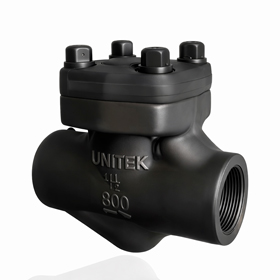
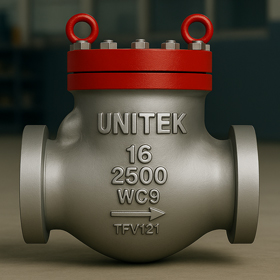
Pressure Seal IBR Check Valve
| Design : | BS 1868/ API 6D/ ASME B 16.34 |
| Face to Face : | ASME B 16.10 |
| Flanges : | ASME B 16.5 |
| Butt Welding : | ASME B 16.25 |
| Testing : | API598/ EN 12266 PART 1 & 2 |
Description
Pressure Seal IBR Check Valve Manufacturer in India
A Pressure Seal IBR Check Valve is a heavy-duty, high-integrity flow control device engineered specifically for severe-service, high-pressure, and high-temperature utility systems. Designed with an advanced pressure seal cover construction, these valves utilize internal system pressure to assist in maintaining a tight body-to-cover seal under demanding operating conditions. Operating automatically through line dynamics, the internal disc moves in response to fluid differentials to provide reliable backflow prevention without requiring manual actuators or handwheels. Compliant with Indian Boiler Regulations, these valves are heavily specified for critical steam networks, thermal power plants, and industrial boiler utilities. Unitek Valves manufactures, supplies, and exports these robust industrial valves from Mumbai to EPC contractors, power plants, and industrial process facilities worldwide.
How a Pressure Seal IBR Check Valve Works
Operating automatically through system line dynamics, a pressure seal IBR NRV functions via differential pressure across the internal closure element:
-
Forward Flow Approach: Process fluid approaches the valve in the intended direction of flow.
-
Differential Pressure Action: Forward differential pressure acts directly on the upstream face of the closing element.
-
Opening Movement: When the forward differential pressure is sufficient to overcome closing forces, the disc moves away from the seat.
-
Fluid Passage: Fluid passes freely through the valve body cavity toward downstream piping.
-
Flow Deceleration: As forward flow velocity decreases or halts, the differential pressure across the valve drops.
-
Closure Assistance: Gravity and the onset of reverse differential pressure drive the closing element back toward the seat ring.
-
Reverse Flow Restriction: The seated element restricts backflow, protecting upstream equipment from pressure surges.
How Pressure Seal Closure Construction Works
The pressure seal mechanism is an engineering approach designed for high-pressure service environments.
-
Sealing Concept: The body-to-cover joint incorporates a pressure seal gasket or ring positioned between the valve body and the underside of the internal cover.
-
Internal Pressure Action: As internal fluid pressure rises within the valve cavity, it exerts an upward force on the cover assembly. This force presses the cover against the pressure seal gasket, energizing the contact surfaces against the body walls to assist the sealing action.
-
Service Considerations: While internal pressure assists the mechanical seal, pressure seal construction requires precision machining, correct material hardness pairing, and meticulous assembly during maintenance turnarounds to ensure reliable performance across thermal cycles. The closure type alone does not determine the overall pressure rating, which depends on the complete valve design, material, and temperature parameters.
High Pressure and High Temperature IBR Check Valve
Industrial steam networks place extreme demands on pipeline components. A High Pressure IBR Check Valve and High Temperature IBR Check Valve must maintain mechanical integrity amidst severe thermal expansion and aggressive media velocities.
-
Engineering Parameters: Valves designed for high-pressure steam lines require thick-walled bodies, specialized alloy steel construction, and precise trim overlays to resist wire-drawing and erosion.
-
Cover and Packing Stability: High-temperature service demands advanced internal component arrangements to protect against thermal degradation.
-
Operational Demands: Proper selection ensures that high-pressure steam check valves deliver stable non-return performance without premature seat wear.
Class 600, 900, 1500 and 2500 Pressure Seal IBR Check Valves
Pressure class designations define a valve’s structural capacity across varying temperature thresholds according to established pressure-temperature ratings.
-
Class 600 & Class 900: Applied in intermediate power generation utility lines and auxiliary high-pressure steam headers.
-
Class 1500 & Class 2500: Specified for main steam lines, boiler feed pump discharge circuits, and supercritical thermal power plant applications.
Allowable working pressures vary dynamically with operating temperatures according to standard pressure-temperature rating tables. Class selection must be evaluated against actual operating pressures, design temperatures, and piping system codes rather than assumed as fixed numerical limits.
Alloy Steel WC6 and WC9 IBR Check Valves
Material selection is vital for valves exposed to elevated temperatures where standard carbon steel loses tensile strength.
-
WC6 & WC9 Material Grades: An Alloy Steel IBR Check Valve is frequently manufactured using ASTM A216 Grade WC6 (1.25% Chromium, 0.5% Molybdenum) or Grade WC9 (2.25% Chromium, 1% Molybdenum) castings.
-
High-Temperature Strength: These chromium-molybdenum alloy steels provide superior resistance to graphitization, creep deformation, and high-temperature oxidation in steam environments.
-
Project Specifications: Material grades must align strictly with design temperature limits and the piping specifications of the project.
ASME B16.34 IBR Check Valve
An ASME B16.34 IBR Check Valve complies with design criteria, wall thicknesses, and pressure-temperature rating tables set forth by ASME B16.34 for valves.
While ASME B16.34 establishes foundational design and manufacturing benchmarks for industrial valves, compliance with this standard does not automatically confer IBR approval. Statutory compliance under Indian Boiler Regulations requires dedicated material test certificates, stage inspections, and verification witnessed by authorized inspecting authorities.
Pressure Seal IBR Check Valve for Boiler and Steam Service
Preventing reverse flow is critical in high-energy steam systems to avoid equipment damage, water hammer induction, and operational instability.
-
Boiler Piping: Installed on feed lines and auxiliary steam headers to prevent backflow toward boilers or headers.
-
High-Pressure Steam Lines: Positioned across main plant distribution loops to isolate branches during shutdown periods.
-
Utility Steam Systems: Utilized in industrial facilities operating high-pressure headers where reliable backflow restriction is mandatory.
Pressure Seal IBR Check Valve for Power Plants
Power generation facilities require rigorous flow control equipment to manage high-energy steam cycles safely:
-
Thermal Power Plants: Turbine lead lines, feedwater regulation circuits, and high-energy drain networks.
-
Power Generation Piping: Boiler drum vents, startup bypass loops, and main steam headers.
-
Process Systems: Heavy industrial power units operating under demanding thermal conditions.
Advantages of Pressure Seal IBR Check Valve
-
Automatic non-return operation requiring no external control power
-
Pressure-assisted body-cover sealing mechanism tailored for high-pressure services
-
Robust alloy steel construction capable of withstanding severe thermal cycling
-
High-pressure class configurations (Class 600 to Class 2500) where specified
-
Compact cover geometry compared to heavy external-flanged bolted designs
-
Statutory IBR compliance documentation available for regulated steam installations
Testing, Inspection and IBR Documentation
Every heavy-duty valve undergoes factory verification before dispatch:
-
Shell Pressure Testing: Hydrostatically tests the valve body and cover to confirm structural containment under elevated test pressures.
-
Seat Leakage Testing: Validates disc-to-seat tightness against specified industrial acceptance standards.
-
Traceability and Compliance: Material test certificates (MTCs) and third-party inspection packages are coordinated to satisfy statutory IBR documentation mandates.
Pressure Seal IBR Check Valve Manufacturer in India
Unitek Valves operates as an established IBR check valve manufacturer in Mumbai, supplying certified high-pressure flow control solutions to domestic and international markets. Every order is backed by strict material traceability, quality control protocols, and comprehensive documentation tailored to project requirements.
How to Select a Pressure Seal IBR Check Valve
-
Confirm whether the application requires automatic non-return backflow prevention.
-
Verify system flow direction and ensure the valve can be mounted in the correct orientation.
-
Determine operating pressure, design pressure, operating temperature, and design temperature limits.
-
Select compatible alloy steel body materials (such as WC6 or WC9) and trim overlays.
-
Choose pressure classes (Class 600, 900, 1500, or 2500) matching piping design parameters.
-
Verify applicable manufacturing standards, test protocols, and mandatory IBR documentation requirements.
| PRODUCT RANGE | SIZE | PRESSURE CLASS |
| Bolted Cover Swing Check Valve | 15 NB to 900 NB | 150# to 600# |
| Forged Steel Lift Check Valve | 6 NB to 50 NB | 800# to 2500# |
| Pressure Seal Swing Check Valve | 50 NB to 600 NB | 900# to 2500# |
| Material : | A216 WCB / A352 LCB / A217 WC1 / A217 WC6 / A217 WC9 / A217 C5 / A217 C12 |
| Trims : | 13CR / SS304 / SS316 / SS304+STELLITED / SS316+STELLITED / SS321 / SS347 / F51 / MONEL |
| Operator : | Self Operated |
| Note : | • Pressure sealed design
• SS inlay on sealing zone for carbon steel valves |
| Optional : | Dash pot arrangement, By pass arrangement |
| Range | Pressure Seal Check Valves | ||||||
| valve | rating | 150 | 300 | 600 | 900 | 1500 | 2500 |
| PSV 108 | inches | – | – | 2″-24″ | 2″-16″ | 2″-12″ | 2″-12″ |
| mm | – | – | 50-600 | 50-400 | 50-300 | 50-300 | |
Only logged in customers who have purchased this product may leave a review.

Reviews
There are no reviews yet.