
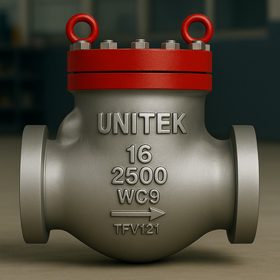
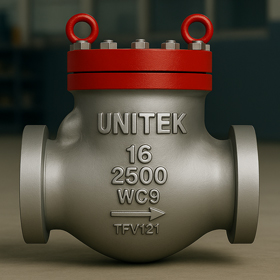
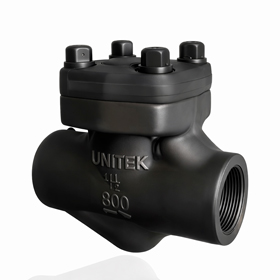
Forged Steel IBR Check Valve
Unitek Valves operates as an established IBR check valve manufacturer based in Mumbai, supplying certified industrial valves to domestic projects and international export markets. Every valve order is supported by strict material traceability, quality assurance inspections, and complete technical documentation tailored to engineering specifications.
Description
Forged Steel IBR Check Valve Manufacturer in India
A Forged Steel IBR Check Valve features a compact, high-integrity body formed through hot forging, which eliminates casting porosity and provides superior structural density for high-pressure applications.
The assembly houses an internal disc or piston-type closing element, a precision-machined seat, and a cover or bonnet arrangement. Unlike linear valves designed for manual isolation or throttling, a check valve functions as an automatic safety device, reacting instantly to changes in system flow velocity and differential pressure. Forged construction ensures that the valve body withstands high-energy water hammer impacts, severe thermal cycling, and continuous high-pressure service.
How a Forged Steel IBR Check Valve Works
Operating automatically through system line dynamics, a forged steel IBR NRV functions via differential pressure across the internal closure element:
-
Forward Flow Approach: Process fluid approaches the valve in the intended direction of flow.
-
Differential Pressure Action: Forward differential pressure acts directly on the upstream face of the closing element.
-
Opening Movement: When the forward differential pressure is sufficient to overcome closing forces (such as component weight and spring resistance where applicable), the disc or piston moves away from the seat.
-
Fluid Passage: Fluid passes freely through the valve body cavity toward downstream piping.
-
Flow Deceleration: As forward flow velocity decreases or halts, the differential pressure across the valve drops.
-
Closure Assistance: Gravity, spring assistance, and the onset of reverse differential pressure drive the closing element back toward the seat ring.
-
Reverse Flow Restriction: The seated element restricts backflow, protecting upstream equipment from pressure surges and reverse contamination.
Forged Steel Lift Check Valve
A Forged Steel Lift Check Valve features a guided piston-type or disc-type closing element that moves linearly within a machined guiding path perpendicular to the seat ring.
-
Guided Movement: The disc lifts vertically away from the seat during forward flow and drops back down into alignment when flow halts.
-
Operational Precision: This linear guidance ensures stable seating under high-velocity flow conditions typical of steam headers.
-
Distinction from Swing Types: Unlike swing check valves that use a hinged arm, a lift check valve operates via axial or vertical travel. Installation orientation must follow manufacturer instructions, as many lift check designs require horizontal piping placement or specific vertical configurations to ensure proper gravity-assisted closing.
ASTM A105 IBR Check Valve
Material selection dictates a valve’s capacity to endure elevated temperatures and mechanical stresses. An ASTM A105 IBR Check Valve utilizes a standardized forged carbon steel specification tailored for ambient and high-temperature service.
-
Material Characteristics: ASTM A105 provides excellent tensile strength, uniform micro-structure, and favorable weldability for socket weld and butt weld installations.
-
Forged Carbon Steel Performance: A forged carbon steel IBR check valve maintains structural integrity in high-pressure steam and condensate lines where standard cast components may be unsuited for extreme stress thresholds.
-
Project Specifications: Material grades must be verified against actual line temperatures, fluid compositions, and piping class requirements.
Class 800 Forged Steel IBR Check Valve
Pressure class ratings establish the structural boundaries of a valve under varying thermal conditions. A Class 800 Forged Steel IBR Check Valve is a standard configuration for compact forged steel piping networks.
-
Structural Design: Class 800 valves feature heavy wall thicknesses designed to handle demanding industrial pressures across high-temperature utility loops.
-
Rating Dynamics: Allowable working pressures vary dynamically with operating temperatures according to standard pressure-temperature rating tables. Class 800 must be evaluated against actual design parameters rather than treated as a fixed numerical pressure limit.
API 602 IBR Check Valve
An API 602 IBR Check Valve complies with design, wall thickness, and dimension criteria outlined in API Standard 602 for compact steel gate, globe, and check valves.
API 602 establishes baseline manufacturing benchmarks for forged steel valves in smaller nominal sizes. However, compliance with API 602 design rules does not automatically confer IBR approval. Statutory compliance under Indian Boiler Regulations requires dedicated material test certificates, stage inspections, and verification witnessed by authorized inspecting authorities.
End Connections for Forged Steel IBR Check Valves
Forged check valves are engineered with specialized end connections to match various piping fabrication standards:
-
Socket Weld IBR Check Valve: Features recessed socket ends where the pipe is inserted and fillet-welded, ideal for high-pressure small-bore piping.
-
Screwed / Threaded IBR Check Valve: Fitted with internal pipe threads (such as NPT or BSP) for mechanical installation where welding is restricted.
-
Butt Weld IBR Check Valve: Configured with bevelled ends designed for full-penetration butt welding into heavy-wall high-pressure systems.
Connection selection depends on piping specifications, pressure classes, and plant maintenance protocols.
Forged Steel IBR Check Valve for Steam and Boiler Service
Preventing backflow in high-energy steam systems is critical to avoid catastrophic equipment damage and operational instability.
-
Steam Pipelines: Installed on main distribution headers to isolate branch lines and prevent reverse steam flow.
-
Boiler Piping: Positioned on auxiliary feedwater circuits, blowdown networks, and boiler drum vent lines.
-
Power Generation Facilities: Utilized in high-pressure steam loops, turbine bypass systems, and condensate recovery circuits where automatic non-return action is mandatory.
Advantages of Forged Steel IBR Check Valve
-
Automatic non-return operation requiring no external control power
-
Robust forged steel body construction eliminating casting defects
-
Compact configuration suitable for high-pressure small-to-medium bore piping
-
Reliable backflow restriction under severe service conditions
-
Class 800 structural designs for demanding pressure-temperature envelopes
-
Multiple end connection options (socket weld, threaded, butt weld)
-
Compliance availability with Indian Boiler Regulations for regulated steam service
Testing and Inspection
Quality verification confirms that every valve meets baseline structural requirements before dispatch. An API 598 IBR Check Valve undergoes factory testing aligned with API 598 standards:
-
Shell Pressure Testing: Hydrostatically tests the forged body and cover to verify structural pressure containment.
-
Seat Leakage Testing: Validates the disc-to-seat shut-off capability against defined industrial acceptance criteria.
-
Documentation & Traceability: Material test certificates (MTCs) verify chemical and mechanical properties. Factory testing protocols complement, but do not replace, statutory IBR inspection mandates.
IBR Requirements and Documentation
Regulatory compliance for boiler installations involves specific verification steps determined by project scopes. Depending on statutory requirements, documentation can include raw material test certificates, dimensional inspection reports, hydrostatic test records, and authorized IBR inspection certificates (such as Form III-C) witnessed by designated inspecting authorities. Verification scope varies based on project location and end-use application.
How to Select a Forged Steel IBR Check Valve
-
Confirm whether the application requires automatic non-return backflow prevention.
-
Verify system flow direction and ensure the valve can be mounted in the correct orientation (especially for lift check designs).
-
Determine operating pressure, design pressure, operating temperature, and design temperature limits.
-
Select appropriate body and trim materials (such as ASTM A105) based on fluid characteristics.
-
Choose pressure classes (such as Class 800) matching piping design parameters.
-
Select appropriate end connections (socket weld, screwed, or butt weld).
-
Verify applicable manufacturing standards, test protocols, and mandatory IBR documentation requirements.
Material of Construction
| Body & Cover | ASTM A 105 – Forged Carbon Steel ASTM A 182 F304/F304L – Forged Stainless Steel ASTM A 182 F316/F316L – Forged Stainless Steel ASTM A 182 F11/F22 – Alloy Steel |
| Trims / Working Parts | ASTM A 276 T – 410(SS-410 – 13% Cr. Steel) ASTM A 276 T – 304/304L(SS-304/SS-304L) ASTM A 276 T – 316/316L(SS-316/SS-316L) Stellited – ST6 |
| Gland Packing | PTFE Virgin/Carbon Filled Teflon Grafoil Ring/Graphite Ring |
| Gasket | SS 304/316 Spiral Wound with Graphite Filled |
| Bolting | ASTM A 193 GR. B7/B8/B8M/A 194 GR. 2H |
Design & Testing Standard
| Design Standard | API 602 / BS 5352 / ASME B16.34 |
| Testing Standard | API 598 |
| Flange End Standard | ASME B16.5/For Face To Face ASME B16.10 |
| End Connection | Flanged End to ASME B16.5, 150#/300#/600#(FLANGES WELDED) Screwed – Threaded End to ASME B1.20.1 Socket Weld End to ASME B16.11 Butt Weld End to ASME B16.25 |
| Operation | Manual, Electric Actuator |
Only logged in customers who have purchased this product may leave a review.

Reviews
There are no reviews yet.