
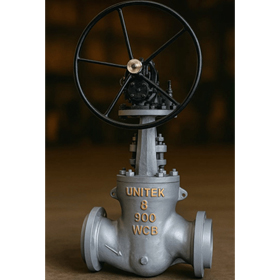
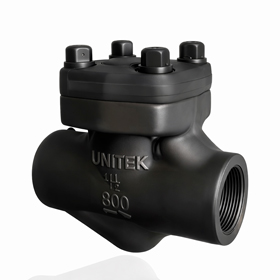
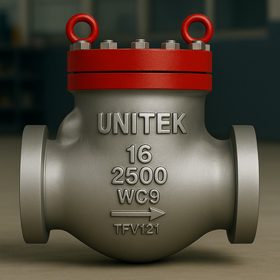
Bolted Bonnet IBR Check Valve
| Design : | BS 1868 / BS 1634 / API 6D/ISO 15761 |
| Face to Face : | AASME B 16.10 |
| Flanges : | ASME B 16.5 |
| Butt welding : | ASME B 16.25 |
| Testing : | API 598 / BS 6755 Part 1 / EN 12266 PART 1 & 2 / API 6D |
Description
Bolted Bonnet IBR Check Valve Manufacturer in India
A Bolted Bonnet IBR Check Valve is an automatic flow control device engineered to permit fluid movement in a single direction while preventing reverse flow in critical piping systems. Also recognized as an industrial non-return valve or IBR NRV, this equipment operates automatically via differential pressure without requiring manual actuators, handwheels, or external operators. Built with a heavy-duty cast steel body and a secure bolted cover arrangement, these valves are heavily specified for steam distribution lines, boiler piping networks, and power generation utilities. Governed by Indian Boiler Regulations, they provide reliable backflow prevention under demanding thermal and operational conditions. Unitek Valves manufactures, supplies, and exports these industrial check valves from Mumbai to EPC contractors, power plants, and industrial buyers worldwide.
How an IBR Check Valve Works
Operating automatically through line dynamics, an IBR Check Valve functions via pressure differentials across the internal closure member:
-
Forward Flow Initialization: When forward flow develops, pressure against the upstream side of the disc exceeds downstream resistance.
-
Opening Action: This forward differential pressure overcomes the weight of the disc and hinge assembly, causing the disc to lift or swing away from the seat.
-
Fluid Passage: Fluid passes freely through the valve body in the intended direction.
-
Flow Deceleration: As forward flow velocity decreases or stops, the differential pressure drops.
-
Closure Assistance: Gravity and the onset of reverse differential pressure assist the disc in swinging back toward the seat ring.
-
Reverse Flow Prevention: The disc seats firmly against the body ring, restricting backflow and protecting upstream equipment from pressure surges.
Swing Check Valve Design
The conventional swing check valve configuration utilizes a simple yet effective mechanical arrangement for backflow protection:
-
Hinged Disc Mechanism: The valve disc is suspended from a pivot point via a robust hinge arm, allowing a wide arc of travel.
-
Automatic Response: The disc swings entirely out of the flow path when open to minimize flow resistance, and returns to a closed position when flow halts.
-
Installation Orientation: Proper installation requires careful attention to flow direction arrows marked on the body. Installation orientation must comply with manufacturer specifications, as horizontal or vertical upward mounting behavior differs based on gravity and hinge design.
Cast Steel WCB IBR Check Valve
Material selection determines a valve’s capacity to handle structural stresses and thermal loads. A Cast Steel IBR Check Valve is frequently specified for industrial utility networks due to its high mechanical strength and ductility.
-
Material Specification: Many standard configurations utilize ASTM A216 WCB, a cast carbon steel specification designed for high-temperature and pressure service.
-
Performance Considerations: WCB offers excellent weldability and structural integrity under moderate steam temperatures.
-
Project Specifications: Material choices must align with the specific operating temperatures, fluid corrosivity, and piping class requirements of the project.
Class 150 and Class 300 IBR Check Valves
Pressure class ratings establish the structural boundaries of a valve under varying thermal conditions. An IBR Check Valve Class 150 and IBR Check Valve Class 300 cater to different operating pressures within industrial plants.
-
Class 150: Applied in lower-pressure utility headers, condensate return lines, and auxiliary plant services.
-
Class 300: Specified for higher-pressure steam distribution headers and heavy-duty process loops.
Allowable working pressures vary dynamically with temperature according to standard pressure-temperature rating tables. Class selection must reflect exact system operating parameters rather than nominal pressure labels.
BS 1868 IBR Check Valve
A BS 1868 IBR Check Valve complies with design and manufacturing parameters outlined in British Standard 1868 for steel check valves.
BS 1868 establishes structural criteria such as wall thicknesses, seat dimensions, and body-cover joint designs. However, adherence to BS 1868 design rules does not automatically constitute IBR approval. Statutory compliance under Indian Boiler Regulations requires dedicated material test documentation, stage inspections, and verification witnessed by authorized inspecting authorities.
Flanged IBR Check Valve
A Flanged IBR Check Valve connects directly to mating pipeline flanges, offering ease of installation and removal during maintenance routines.
-
Mating Compatibility: Flange dimensions and drilling conform to established standards (such as ASME B16.5) to align with standard piping layouts.
-
Gasket Sealing: Raised face or flat face configurations accommodate specified joint gaskets to maintain leak-tight exterior containment.
-
Structural Stability: Bolted flanged connections distribute mechanical pipe loads evenly across the valve body ends.
IBR Check Valve for Steam and Boiler Applications
Preventing reverse flow is critical in high-energy steam systems to avoid equipment damage, water hammer induction, and operational instability.
-
Boiler Piping: Installed on feed lines and auxiliary steam headers to prevent backflow toward boilers or headers.
-
Steam Distribution Networks: Positioned across main plant distribution loops to isolate branches during shutdown periods.
-
Power Generation Facilities: Utilized in auxiliary turbine systems, condensate extraction lines, and high-pressure utility loops where automatic non-return action is mandatory.
Advantages of Bolted Bonnet IBR Check Valve
-
Automatic non-return operation requiring no external control power
-
Reliable backflow prevention under normal operating cycles
-
Simple swing-disc mechanism minimizing mechanical wear points
-
Cast steel body options delivering high structural strength
-
Bolted cover construction permitting internal inspection and servicing
-
Standard flanged connections for straightforward pipeline integration
-
Compliance availability with Indian Boiler Regulations for regulated steam service
Testing and Inspection of IBR Check Valves
Quality verification confirms that every valve meets baseline structural requirements before leaving the manufacturing facility. An API 598 IBR Check Valve undergoes factory testing aligned with API 598 standards:
-
Shell Pressure Testing: Hydrostatically tests the cast body and cover to verify pressure containment integrity.
-
Seat Leakage Testing: Assesses the disc-to-seat shut-off capability against defined acceptance criteria.
-
Traceability: Material test certificates (MTCs) verify chemical and mechanical properties. Factory testing protocols complement, but do not replace, statutory IBR inspection mandates.
IBR Requirements and Documentation
Regulatory compliance for boiler installations involves specific verification steps determined by project scopes. Depending on statutory requirements, documentation can include raw material test certificates, dimensional inspection reports, hydrostatic test records, and authorized IBR inspection certificates (such as Form III-C) witnessed by designated inspecting authorities. Verification scope varies based on project location and end-use application.
Bolted Bonnet IBR Check Valve Manufacturer in India
Unitek Valves operates as an established IBR check valve manufacturer based in Mumbai, supplying certified industrial valves to domestic projects and international export markets. Every valve order is supported by strict material traceability, quality assurance inspections, and complete technical documentation tailored to engineering specifications.
How to Select an IBR Check Valve
-
Confirm whether the application requires automatic non-return backflow prevention.
-
Verify system flow direction and ensure the valve can be mounted in the correct orientation.
-
Determine operating pressure, design pressure, operating temperature, and design temperature limits.
-
Select appropriate body and trim materials (such as ASTM A216 WCB) based on fluid characteristics.
-
Choose pressure classes (such as Class 150 or Class 300) matching piping design parameters.
-
Verify applicable manufacturing standards, test protocols, and mandatory IBR documentation requirements.
| Material : | ASTM Specifications Carbon Steel,Alloy Steel,Low Temperature carbon Steel, Stainless Steel, Duplex Stainless Steel,Super Duplex Stainless Steel,any other special material. |
| Moc : | WCBL / LCB / CF8 / CF8M / WC6 / WC9 |
| Trims : | CS 13% CR / CF8 / CF8M / Stellite |
| Operator : | Self Operated |
| Ends : | Flanged, Butt Weld |
| Note : | • Bolted cover,
• Male Female Body Bonnet Joints for ratings ≤ 900 Ibs , • RTJ Joints on request. • RTJ Body Bonnet Joints for ratings ≥ 1500 Ibs (standard) |
| Optional : | By pass arrangement , Dash pot / hydraulic non-slam arrangement |
| Valve | Swing Check Valve | ||||||
| Range | Class | 150 | 300 | 600 | 900 | 1500 | 2500 |
| CHV 108 | inches | 2″-30″ | 2″-24″ | 2″-24″ | 2″-16″ | 2″-12″ | 2″-12″ |
| mm | 50-750 | 50-600 | 50-600 | 50-400 | 50-300 | 50-300 | |
Only logged in customers who have purchased this product may leave a review.

Reviews
There are no reviews yet.