
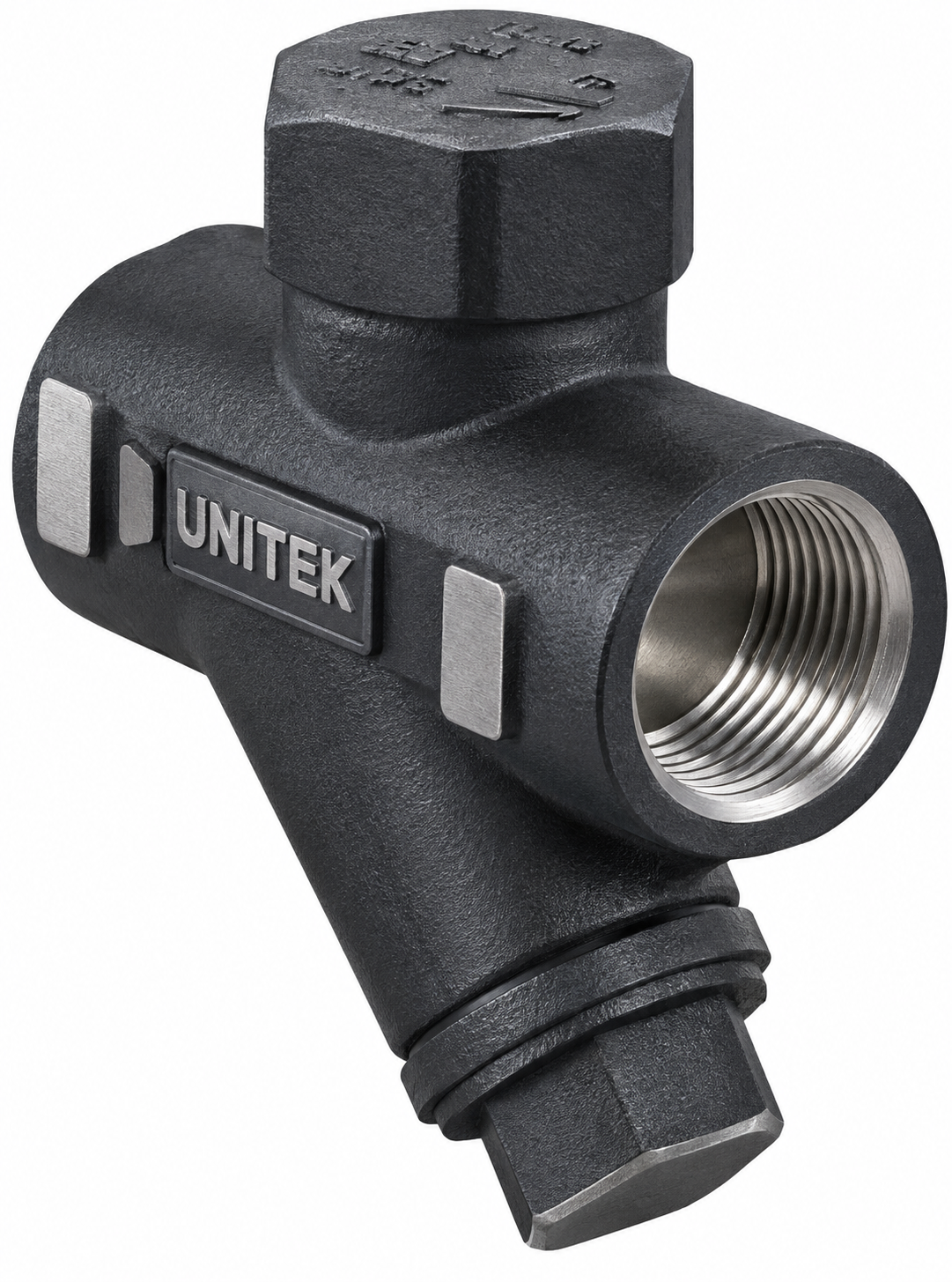
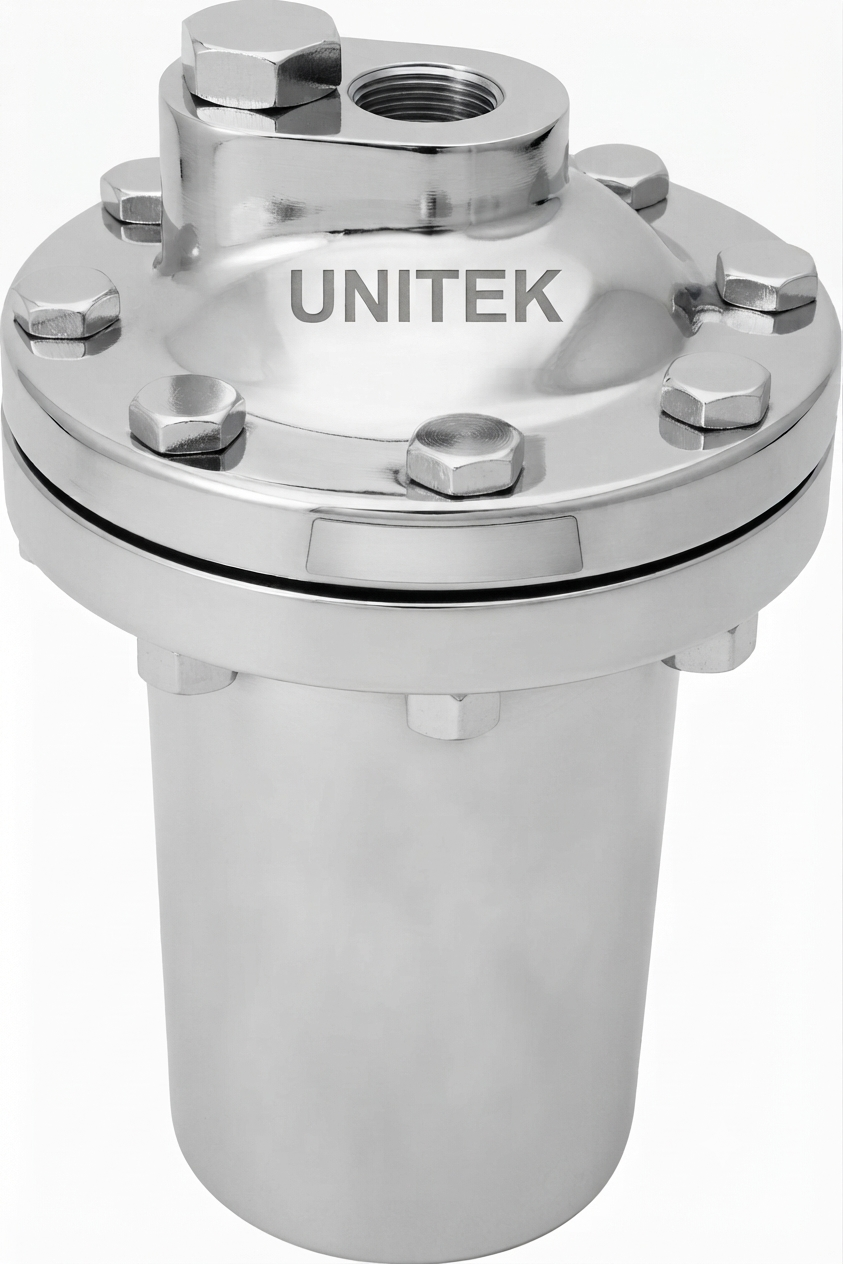
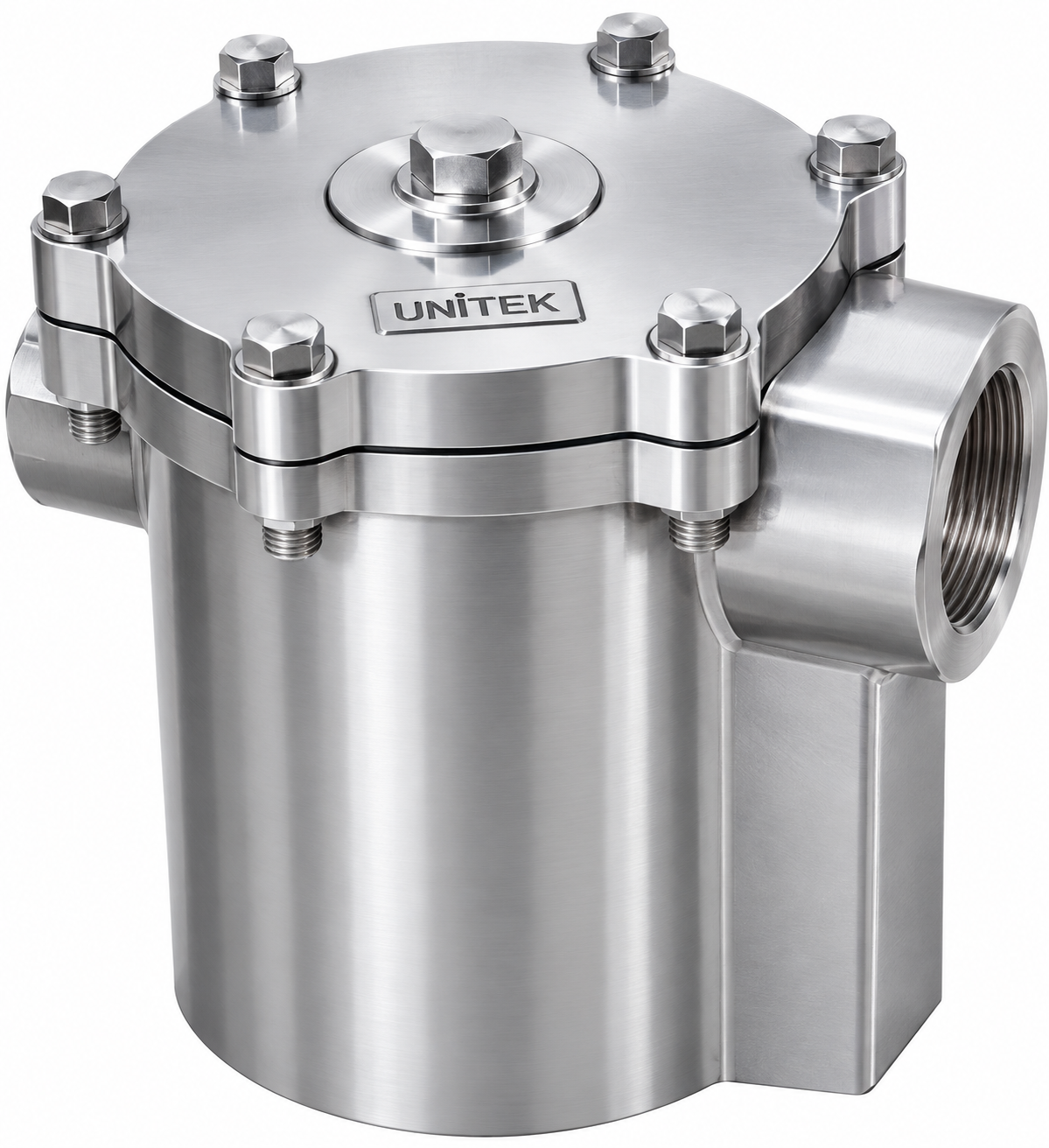
HORIZONTAL INVERTED BUCKET TYPE STEAM TRAP
Product Description
| Body : | CAST IRON (IS 210 Gr FG 200) |
| Trims : | 13 Cr | 18 Cr 8 Ni |
| Cover : | CAST IRON (IS 210 Gr FG 200) |
| Max Inlet Pressure : | 10.54 Kg/Cm ² AT 220 °C |
| MFG STD : | IS 12268 |
| INSP & TEST STD : | IS 12268 |
| Ends : | SCREWED TO BSP |
| HYD Test Pressure : | BODY : 300 Psig (21 Kg/Cm ²) |
| Size Range : | 15 MM TO 50 MM |
Description
Horizontal Inverted Bucket Type Steam Trap Manufacturer in India
An efficient steam distribution and condensate management network is essential for industrial process heating, boiler efficiency, and reliable plant operation. In industrial steam networks, the continuous generation of condensate is an inevitable thermodynamic consequence of heat transfer. Removing this liquid efficiently while retaining live steam requires specialized mechanical devices.
Unitek Valves operates as a trusted manufacturer, supplier, and exporter of industrial valves and steam-system products based in Mumbai, India, delivering dependable condensate-management solutions to domestic processing plants and international export markets. Among the core offerings for steam and boiler applications, the Horizontal Inverted Bucket Type Steam Trap provides reliable mechanical operation, durability, and consistent performance across diverse industrial sectors.
What is a Horizontal Inverted Bucket Type Steam Trap?
A Horizontal Inverted Bucket Type Steam Trap is a specialized mechanical automatic valve designed to discharge condensed water from industrial steam systems while restricting the escape of live steam under suitable operating conditions.
-
Steam Trap Function: The primary function of any steam trap is to automatically drain condensate, air, and non-condensable gases from steam lines or heat exchangers while preventing live steam loss.
-
Mechanical Steam Trap Principle: Unlike thermostatic traps that operate on temperature differences or thermodynamic traps that rely on velocity and pressure dynamics, an inverted bucket steam trap operates on the mechanical principles of buoyancy and gravity acting upon a submerged, inverted bucket.
-
Inverted Bucket Construction: Inside the trap body, an open-top bucket is inverted over an orifice connected to the discharge valve mechanism via a lever assembly.
-
Automatic Operation: The trap cycles automatically between discharging condensate and retaining steam based on the changing buoyancy state of the bucket.
-
Steam Retention: When steam fills the upper portion of the inverted bucket, it displaces water and creates buoyancy, lifting the bucket and closing the valve mechanism to hold live steam within the system.
How Does an Inverted Bucket Steam Trap Work?
The operational cycle of a Horizontal Inverted Bucket Steam Trap relies on a sequence driven by fluid levels, buoyancy, and internal mechanical linkage:
-
Condensate Entry: Condensate entering the trap body flows down around the outside of the inverted bucket and fills the bottom of the trap.
-
Initial Submerged Position: When the trap contains cool condensate or air, the inverted bucket initially remains in a downward position, resting on its support.
-
Valve Mechanism Open: In this downward position, the lever holds the discharge valve open, allowing accumulated condensate, air, and non-condensable gases to flow freely through the orifice and out the discharge passage.
-
Steam Entry: As condensate is cleared, steam enters the underside of the inverted bucket, rising and displacing the water inside it.
-
Buoyancy and Rise: The accumulation of steam inside the inverted bucket makes it buoyant, causing it to float and rise.
-
Valve Closure: As the bucket rises, the attached lever mechanism moves the valve plug upward, restricting or closing the discharge orifice against the internal steam pressure.
-
Condensation Cycle: Trapped steam inside the bucket gradually condenses and escapes through a small vent hole in the top of the bucket, while incoming cool condensate replaces the steam surrounding the exterior.
-
Loss of Buoyancy: As steam condenses and condensate fills the trap body again, the bucket loses its buoyancy and sinks back down.
-
Valve Reopening: The downward movement of the bucket pulls the valve away from its seat, opening the discharge path and releasing the newly accumulated condensate.
-
Cycle Repetition: The operating cycle repeats continuously according to the prevailing operating conditions, condensate load, and steam-system dynamics.
Importance of the Water Seal
For an inverted bucket steam trap to function correctly, a permanent water seal must be maintained around the open bottom of the bucket. This water seal acts as a barrier preventing live steam from escaping directly through the bucket vent hole when the valve is closed. During initial commissioning or after a system shutdown, the trap body must be primed with water to establish this essential seal.
Horizontal Inverted Bucket Steam Trap Design & Construction
A robust structural design enables the trap assembly to withstand demanding thermal cycles and operating pressures. Standard structural elements include:
-
Body: Houses the internal components and provides the inlet and outlet flow paths configured for horizontal piping arrangements.
-
Cover (Cap): Encloses the top of the trap body and secures access to internal mechanisms.
-
Inverted Bucket: The core buoyancy element, featuring a vent hole at the top to release air and steam into the upper body chamber.
-
Valve Mechanism: Precision-machined valve plug that controls flow through the discharge orifice.
-
Valve Seat: The mating surface against which the valve plug seals.
-
Lever/Linkage Mechanism: Connects the inverted bucket to the valve plug, multiplying the buoyancy force to operate against system pressure.
-
Inlet and Outlet Passages: Direct fluid flow into and out of the internal operating zone.
Why is the Horizontal Orientation Important?
The horizontal configuration of a Horizontal Inverted Bucket Steam Trap plays a critical role in its physical installation and mechanical performance:
-
Piping Layout: Designed specifically for horizontal pipeline arrangements, ensuring that the internal bucket hangs level and moves vertically without binding against the body walls.
-
Drainage Alignment: Facilitates natural gravity flow of condensate into the inlet port and smooth discharge from the outlet connection.
-
Maintenance Accessibility: Horizontal body designs often position covers or internal assemblies for convenient inspection and servicing without removing the entire body from the piping run.
-
Manufacturer Guidelines: Proper installation must strictly follow the manufacturer’s specified mounting orientation to ensure the bucket operates freely and the water seal remains intact.
Horizontal Inverted Bucket Steam Trap for Boiler Systems
Boiler installations and associated steam generation loops handle high-energy environments where efficient moisture control is vital. A Horizontal Inverted Bucket Steam Trap for Boiler Systems is frequently specified for boiler auxiliary lines, header drain points, and main steam collection loops. Reliable condensate drainage protects auxiliary equipment, supports stable steam generation, and maintains dry steam delivery across the facility.
Horizontal Inverted Bucket Steam Trap for Steam Pipelines
Steam distribution pipelines stretch across extensive industrial facilities, where thermal radiation through pipe walls inevitably generates condensate. Installing a Horizontal Inverted Bucket Steam Trap for Steam Pipelines at strategic drain points and risers along the distribution network keeps headers clear of accumulated liquid. Proper condensate removal supports stable steam-system operation and helps maintain dry steam supply at point-of-use equipment.
Horizontal Inverted Bucket Steam Trap for Power Plants
Thermal power plants and co-generation facilities handle massive steam volumes operating at elevated pressures and temperatures. A Horizontal Inverted Bucket Steam Trap for Power Plants plays an important role in managing condensate across turbine bypass systems, auxiliary steam headers, and power plant utility networks, ensuring that moisture is effectively removed from high-energy circuits.
Horizontal Inverted Bucket Steam Trap for Industrial Piping
Industrial manufacturing relies heavily on clean, reliable process steam for heating, evaporation, jacketed vessels, and heat exchangers. Suitable applications for industrial inverted bucket steam traps are found across:
-
Chemical processing plants
-
Petrochemical units
-
Oil & Gas facilities
-
Manufacturing and textile units
-
Industrial steam utility networks
-
Process heating systems
Final suitability depends strictly on actual operating conditions, pressure differentials, and specific project requirements.
Materials & Construction
A robust structural design ensures that the body shell and internal components withstand demanding thermal cycling and pressure forces. Possible materials include:
-
Cast Iron: Widely specified for general industrial steam distribution lines and utility networks within standard pressure ranges.
-
Carbon Steel: Utilized in robust industrial applications requiring higher mechanical strength and resistance to thermal shock.
-
Cast Steel: Applied in demanding steam utility and power piping systems.
-
Stainless Steel: Selected for corrosion resistance and longevity in aggressive environments or clean steam service.
Actual material selection depends strictly on steam conditions, operating pressure, temperature, corrosion conditions, specific application, and project specifications.
Screwed, BSP and Flanged Connections
Connection arrangements must match the piping specifications of the installation site:
-
Screwed and BSP Connections: Utilized on smaller-size piping installations where threaded pipe joints are specified.
-
Flanged Connections: Provided where bolted flange joints are required for heavy-duty industrial piping and maintenance accessibility.
Connection availability depends strictly on the confirmed product design and manufacturing specifications.
Installation of Horizontal Inverted Bucket Steam Trap
To ensure proper functionality, installation practices should follow established engineering guidelines:
-
Flow Direction: Verify that the flow direction arrow on the trap body matches pipeline flow.
-
Horizontal Orientation: Install the trap with the body in a true horizontal position to allow the bucket to move vertically without friction.
-
Water Seal Priming: Ensure the trap is properly primed with water before initial startup to establish the internal water seal.
-
Piping Support: Provide adequate pipe supports upstream and downstream to prevent mechanical stress on the trap body.
-
Accessibility: Position the trap in an accessible location for routine inspection and maintenance.
-
Debris Protection: Install a strainer upstream of the trap to protect internal components from weld slag, rust, and pipe scale.
-
Manufacturer Instructions: Always adhere to the manufacturer’s specific installation recommendations.
Maintenance of Inverted Bucket Steam Traps
Regular inspection and maintenance help ensure sustained operational performance:
-
Periodic Inspection: Check trap operation during routine plant maintenance rounds to identify continuous blow-through or failure to discharge.
-
Internal Component Check: Inspect the inverted bucket, valve plug, seat, and lever linkage for wear or deposit accumulation.
-
Cleaning: Clean internal passages and the bucket vent hole where required.
-
Water Seal Verification: Confirm that the water seal is intact during operational checks.
-
Pipeline Review: Check upstream and downstream piping conditions for corrosion or blockage.
-
Manufacturer Guidelines: Always follow the manufacturer’s recommended maintenance and replacement procedures.
Selection of Horizontal Inverted Bucket Steam Trap
Proper selection is vital to achieving efficient condensate removal and preventing thermal energy loss. Procurement and engineering teams should evaluate the following factors:
-
Steam pressure and operating pressure range
-
Operating temperature limits
-
Condensate load requirements
-
Differential pressure across the trap (inlet pressure minus back pressure)
-
Installation orientation and piping arrangement
-
Trap discharge capacity
-
Body material compatibility
-
End connection type and size
-
Steam-system conditions
-
Specific project requirements
Inspection, Testing & Documentation
Compliance and documentation protocols vary based on the specific product design, service application, and contractual project specifications. Depending on order requirements, documentation scope may include:
-
Material test certificates for pressure-retaining components
-
Visual inspection records
-
Dimensional inspection reports
-
Pressure testing where applicable
-
Product test certificates
-
Third-party inspection coordination, where specified by the client
-
Project documentation
Benefits of Horizontal Inverted Bucket Steam Traps
-
Mechanical Operating Principle: Operates reliably using buoyancy and gravity without complex electronic sensors.
-
Automatic Condensate Discharge: Responds dynamically to changing condensate loads and steam presence.
-
Robust Construction: Durable internal linkage and heavy-duty body design suitable for industrial service.
-
Good Resistance to Water Hammer: Mechanical design handles hydraulic shocks better than delicate thermostatic elements.
-
Application Flexibility: Available in various materials and connection types to match project specifications.
Horizontal Inverted Bucket Steam Trap Manufacturer, Supplier & Exporter in India
UNITEK VALVES is a recognized manufacturer, supplier, and exporter of industrial valves and steam-system products based in Mumbai, India. Serving domestic processing plants and international industrial markets, the company provides dependable pipeline and condensate management solutions supported by rigorous quality control and material traceability.
The company provides dedicated support for:
-
Technical requirement review and parameter analysis
-
Product selection guidance for industrial steam and boiler applications
-
Inspection and testing coordination
-
Documentation preparation
-
Domestic supply across India and international export enquiries
How to Select the Right Horizontal Inverted Bucket Steam Trap
Procurement and engineering teams should evaluate system requirements systematically:
-
Identify the specific steam application (e.g., steam main drip leg, header drain, or process equipment).
-
Determine operating inlet pressures and maximum working temperatures.
-
Calculate the available differential pressure across the trap.
-
Estimate condensate load requirements under normal operating and startup conditions.
-
Confirm body material, end connection types, and size specifications.
-
Verify horizontal installation orientation and maintenance access requirements.
-
Review applicable project specifications and documentation standards.
Only logged in customers who have purchased this product may leave a review.

Reviews
There are no reviews yet.